
VIIZR QuickBooks Integration: Empowering Small Businesses with Financial Efficiency

Leading QuickBooks Integration at VIIZR through Engineering Collaboration

Connecting VIIZR and Quickbooks

Designing a two-way accounting integration to reduce manual work for small business owners.

VIIZR was a business management platform powered by Ford Pro and built on Salesforce, designed to help small businesses manage their day-to-day operations.

After joining the VIIZR product team, I worked across several initiatives focused on improving the experience for businesses in the trades. One of the most requested features was a QuickBooks integration.

I led the product design work for the integration, helping define how customers could connect their accounts, import their existing QuickBooks data into VIIZR, and continue syncing information between both platforms.

Role

Product Designer

Responsibilities

Research synthesis
User flows
Wireframes
Prototyping
UI design
Usability testing Engineering collaboration
QA

Team

Product, Design
Research
Engineering

Platform

Web & Mobile App

Designing for Two Systems

The biggest challenge was making QuickBooks and Salesforce behave like one experience.

Although customers experienced the integration as a connection between two products, behind the scenes we were working across different systems, data structures, and technical requirements.

VIIZR was built on Salesforce, which meant our designs needed to follow Salesforce patterns, components, and technical constraints. Our mobile experience also had to account for the React-based framework used by the product.

QuickBooks introduced another layer of complexity.

Customer records, invoices, payments, and price book items needed to map correctly between both platforms. Incorrect mapping could result in incomplete information or missing financial data.

I worked closely with engineers throughout the design process to understand these limitations and translate them into an experience that felt simple to the customer.

‍The complexity needed to live behind the interface, not in front of the user.

From Connection to Two-Way Sync

We designed the integration to support how businesses actually worked.

The integration wasn't simply an initial QuickBooks import.

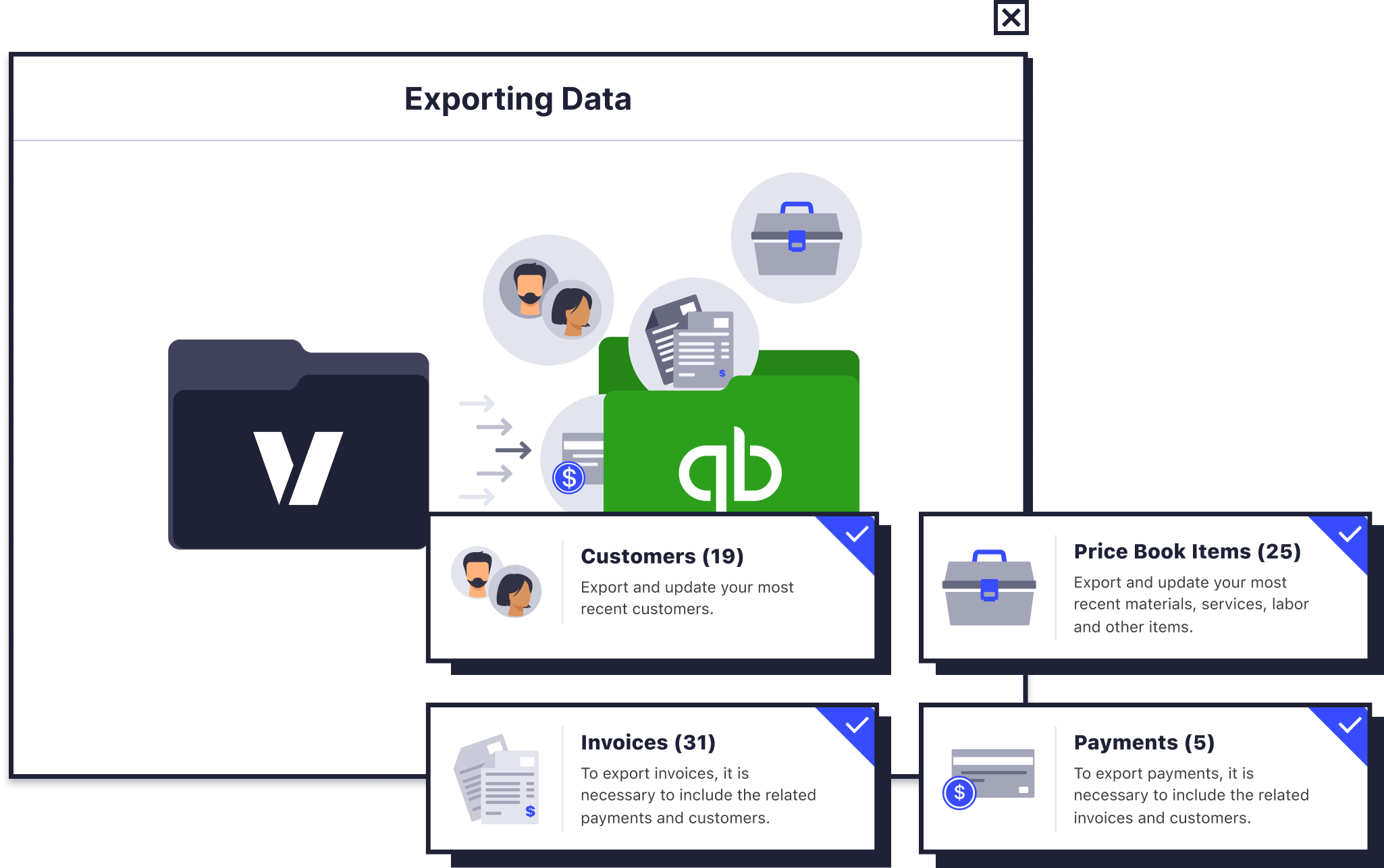
We designed a two-way synchronization that allowed information to move between QuickBooks and VIIZR, including:
‍Customers · Invoices · Payments · Price book items

‍
This allowed businesses to continue managing their operations in VIIZR while keeping their accounting workflow connected to QuickBooks.

One of our biggest design questions became:

What happens after the first sync?

‍
We needed customers to understand what had already been imported, what could continue syncing, which date ranges were included, and how future information would move between the two systems.

Making that behavior understandable became just as important as making the initial connection successful.

Designing Beyond the Happy Path

Financial integrations need to work when things don't go as planned.

Connecting two existing databases introduced scenarios that couldn't be solved by designing only the ideal flow.

I created flows and states for edge cases including:

‍Duplicate customers
What happens when the same customer already exists in VIIZR and QuickBooks?

‍Permission issues
What happens when a user's QuickBooks permissions don't allow VIIZR to access or sync certain information?

‍Sync failures
How do we communicate when information fails to transfer between platforms?

‍Authentication issues
How do customers recover when the connection between the two accounts fails?

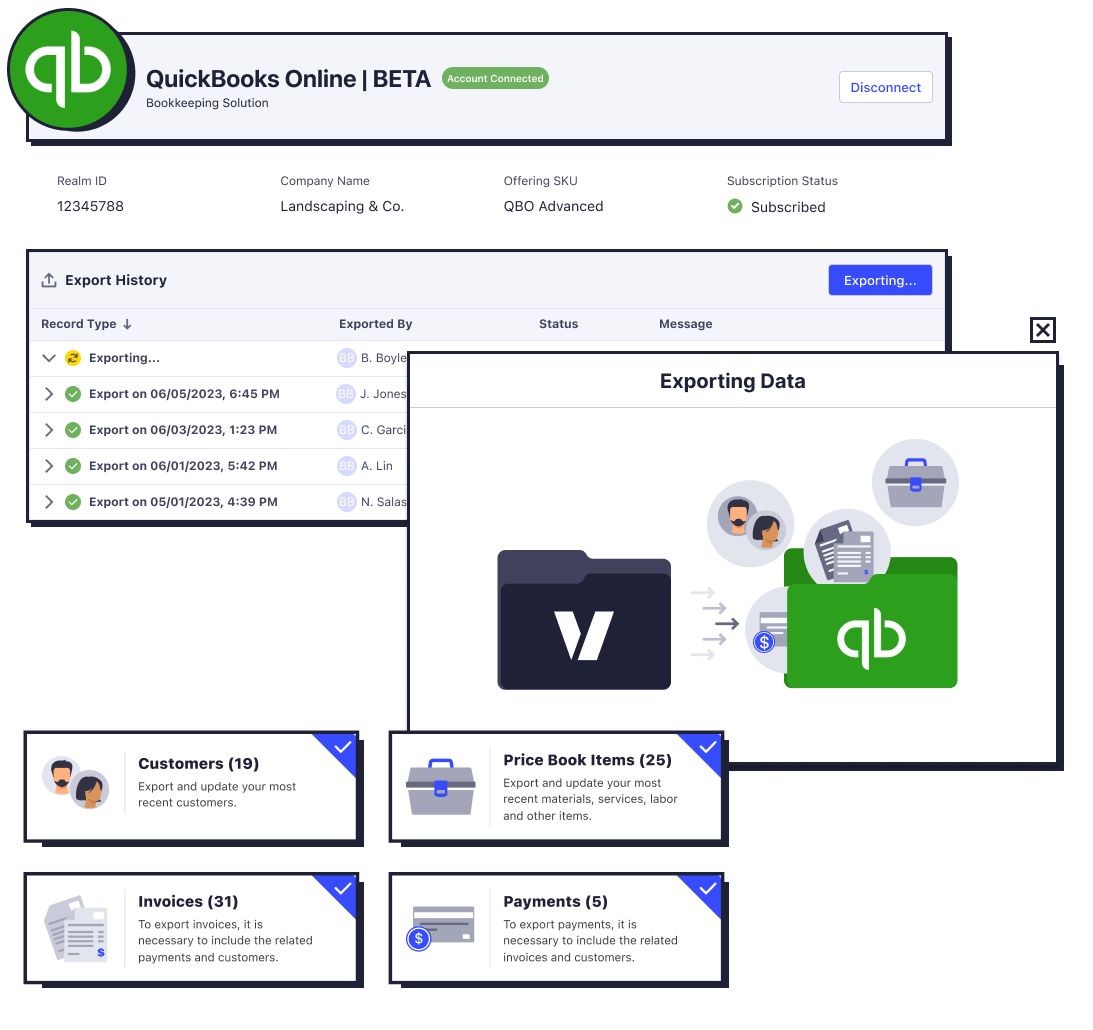
‍Export history
Which system contains the most accurate or recent information, and how do we determine what should be synchronized?

Working through these scenarios helped us reduce the possibility of incorrect or duplicated financial information while giving customers clearer feedback when something required their attention.

Iterating Toward the Pilot

The final experience was the result of 11 iterations.

The integration evolved significantly throughout the project.

Early versions surfaced challenges around authentication, customer exports, data mapping, and determining the correct history to use when information existed in both systems.

Rather than treating these as purely engineering problems, we continued adjusting the experience alongside technical development.

We created and tested prototypes to understand how customers moved through the setup process and where additional context or control was necessary.

Across 11 design iterations, we refined the experience before reaching the version used for the pilot.

Each iteration brought us closer to an experience that balanced three things:

‍Customer expectations
QuickBooks data requirements
Salesforce technical constraints

The Final Experience

Connect once. Bring your business data together.

The final onboarding experience guided customers through connecting their QuickBooks account and choosing exactly what information they wanted to bring into VIIZR.

01 — Connect QuickBooks
Customers securely connected their existing QuickBooks Online account to VIIZR.

02 — Choose what to import
Rather than automatically importing everything, customers could choose the customers and information relevant to their business.

03 — Configure products and services
‍
Customers selected whether they wanted to import inventory, non-inventory items, services, or a combination of them.

‍04 — Define the timeframe
‍
Users could import their complete history or select a specific date range, giving them greater control over their existing records.

‍05 — Import and verify
‍
VIIZR communicated the import status so customers knew when their information was being processed and when the connection was ready.

‍06 — Keep VIIZR and QuickBooks connected
‍
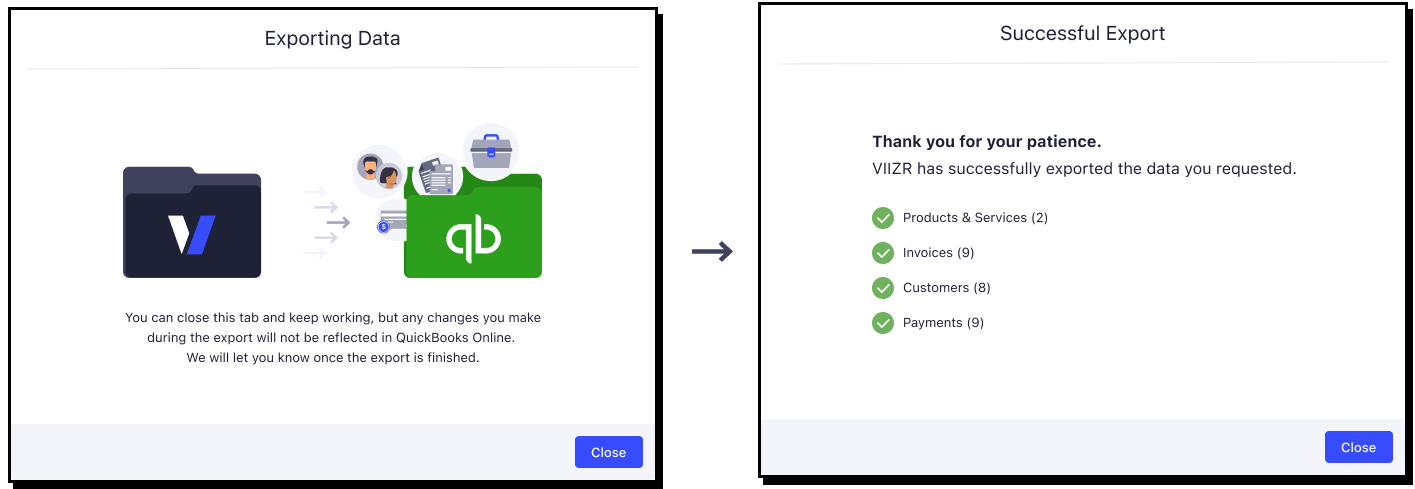
Once setup was complete, customers could begin exporting and syncing information between VIIZR and QuickBooks as part of their regular workflow.

Launching the Pilot

From 11 iterations to a working integration.

The QuickBooks integration progressed to a pilot program in Q3 2023.

Reaching the pilot represented an important milestone for the team: we had taken one of our customers' most requested capabilities and transformed it into a functioning two-way integration.

The pilot gave us an opportunity to validate the experience in real business workflows and gather feedback for future improvements.

While quantitative post-launch metrics weren't available during my time on the project, successfully reaching the pilot allowed us to validate the technical and UX feasibility of connecting two complex platforms while addressing a significant gap in the VIIZR experience.

Taking the Experience Beyond the Product

I also helped bring the integration to market.

My involvement didn't stop once the product experience was complete.

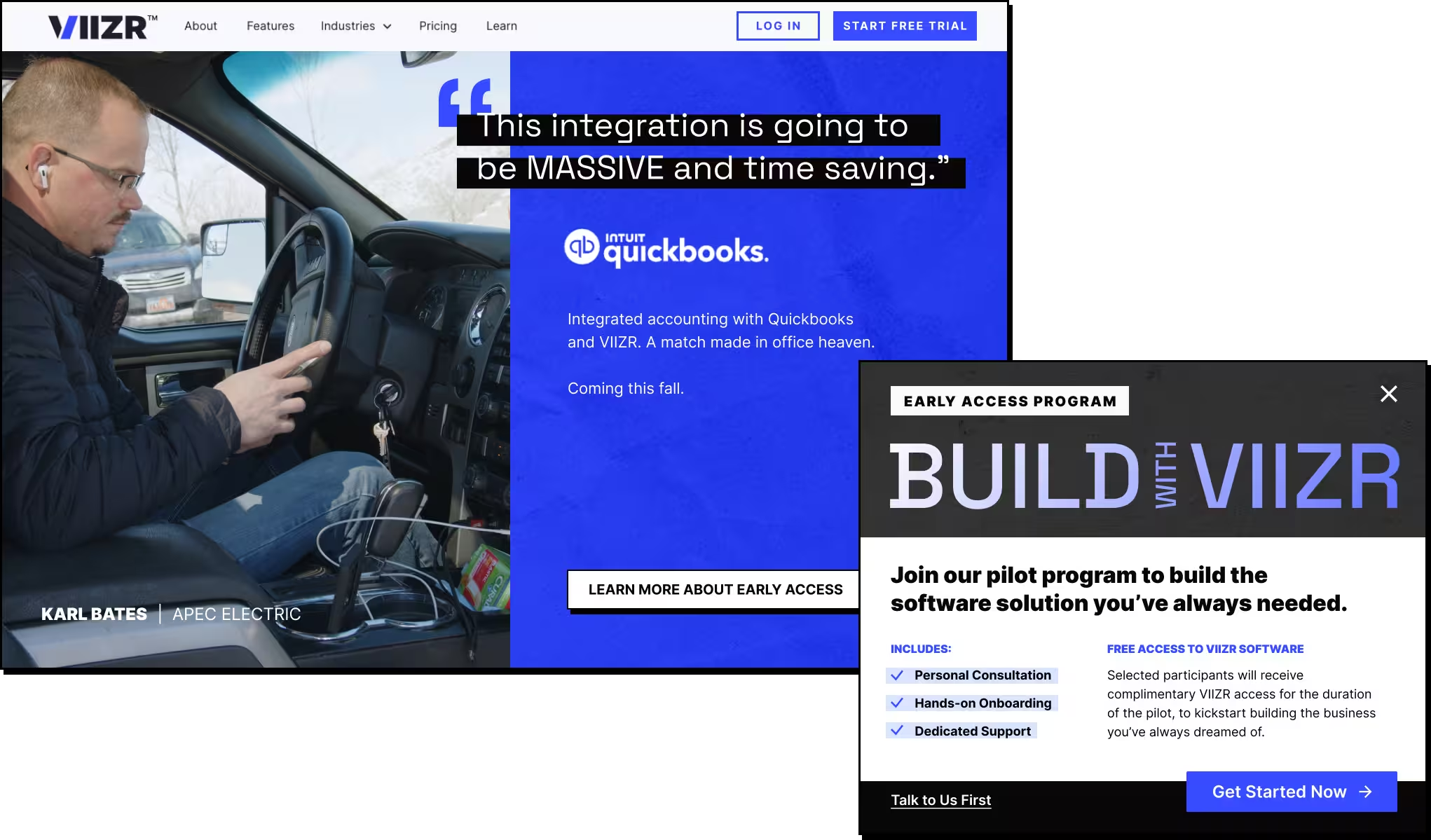
I partnered with the marketing team to help communicate the value of the QuickBooks integration to existing and prospective customers.

I designed and developed web experiences and created supporting graphics and marketing assets for the launch.

Working across both product and marketing gave me the opportunity to think about the entire customer journey: from discovering the integration to connecting an account and ultimately using it as part of their everyday workflow.

What I Learned

Sometimes the simplest experience requires solving the most complexity behind the scenes.

The most challenging part of this project was connecting systems that weren't originally designed to behave as one product.

QuickBooks had its own data structures and requirements. Salesforce had its own design system and development constraints. And our customers didn't need to understand any of that complexity.

They simply needed their information to work.

Working closely with engineering throughout 11 iterations reinforced something that continues to influence how I approach product design:

‍A successful integration isn't about exposing how two systems connect. It's about making the connection feel invisible.

‍
Seeing the final experience successfully connect VIIZR and QuickBooks was one of the most rewarding parts of the project.

It moved VIIZR closer to the all-in-one experience our customers were asking for, allowing small business owners to spend less time manually managing information across products and more time running their businesses.

See Next
PRODUCT DESIGN LEAD @ VIIZR POWERED BY FORD PRO

Enhancing VIIZR Mobile App Experience: Introducing the Multi-Day Feature for Improved Planning in 2023

At VIIZR, I took a holistic approach, overseeing the research phase, collaborating with the engineering team, and handing off design files to enhance the mobile user experience, expanding the app's capabilities to view multiple days ahead.

Click here to view case study.